

Hydrochoerus hydrochaeris
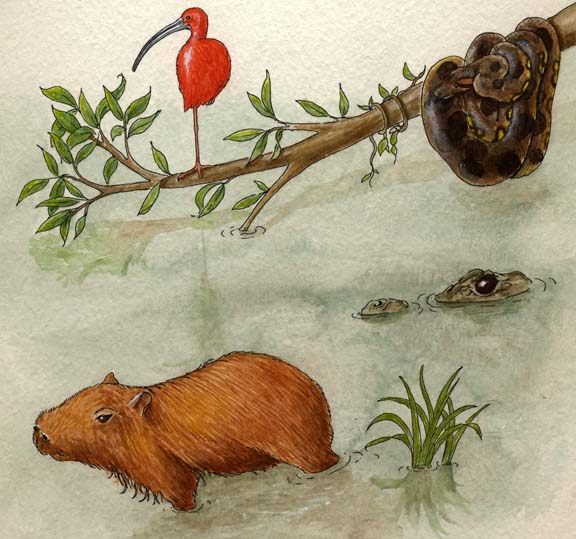
Range
The capybara is found in Central and South America; in Panama, the Andes Mountains, Columbia, Uruguay, Brazil, and Argentina.Habitat
They live in thick, brushy areas, always near water. They are found in the Amazon Rainforest.Body Traits
They are the largest rodents in the world. Rodents are a family of mammals that gnaw (chew) with 2 pairs of sharp front teeth called incisors. Capybaras have round bodies. They weigh from 75-140 pounds (females are slightly larger). They grow to more than 4 feet long. Their color is from yellow-brown to reddish.Habits
They are active mostly at night (nocturnal). They rest in their burrows during the day. They live in large groups of 20 or more. They have 1 lead male and several females and smaller males. They bark and whistle to communicate with each other.Diet
They eat water plants, grass, vegetables and tree bark.Predators
Predators that eat them are anacondas, caimans, jaguars and man.Reproduction
The females are pregnant for 4-5 months (gestation). They have about 5 babies. They usually have 1 litter a year, but sometimes have 2 litters. All the females share taking care of the babies.Lifespan and/or Conservation Status
They can live 8-10 years in the wild. They are not endangered in farming areas, but capybaras along the Amazon River are greatly reduced because of habitat loss.
Classification
- Kingdom: Animalia
- Phylum: Chordata
- Subphylum: Vertebrata
- Class: Mammalia
- Order: Rodentia
- Suborder: Hystricomorpha
- Family: Caviidae
- Subfamily: Hydrochoerinae
- Genus: Hydrochoerus
- Species: Hydrochoerus hydrochaeris