

Rangifer tarandus granti, Rangifer tarandus caribou
Range
They are found in northern Europe, Asia, Alaska and Canada south into northeastern Washington and northern Idaho.Habitat
They live on the tundra and taiga.Body Traits
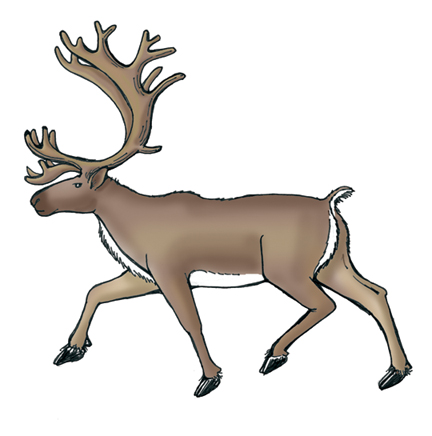
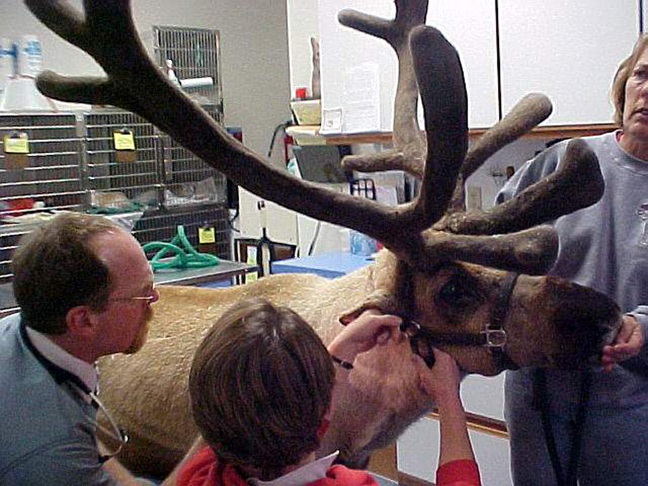
A male caribou can weigh up to 600 pounds and reach 7 feet long, while females reach 300 pounds. They have thick, brown fur with a white neck, backside and belly. They have a long nose and a hairy beard called a dewlap. They have long legs with big, rounded hooves that are covered with fur in the winter for walking on ice. Both males and females have antlers, but the males’ are larger and more branched. They are the only members of the deer family where the females have antlers as well as the males. *Reindeer and caribou are the same species, but there are several subspecies between them. They are more often called reindeer when they are kept by humans (captivity).Habits
They travel in herds moving around in search of food. This traveling is called migration and can cover thousands of miles every year. Caribou can run up to 50 miles per hour. They can also swim when traveling on the wet summer tundra.Diet
They eat grasses and sedges, lichens, mushrooms, birch twigs, and willow leaves.Predators
They are hunted by grizzlies, black bears, cougars, wolverines, lynx, coyotes, and golden eagles.Reproduction
Males will compete and even fight for females, collecting 5-15 in a group called a harem. Females are pregnant for 7-8 months (gestation). They have 1-2 calves. Calves can stand very quickly after they are born so they can keep up with the herd.Lifespan and/or Conservation Status
They can live up to 15 years in the wild. They are listed as endangered in some regions because of habitat loss. They are extinct is some of their original range.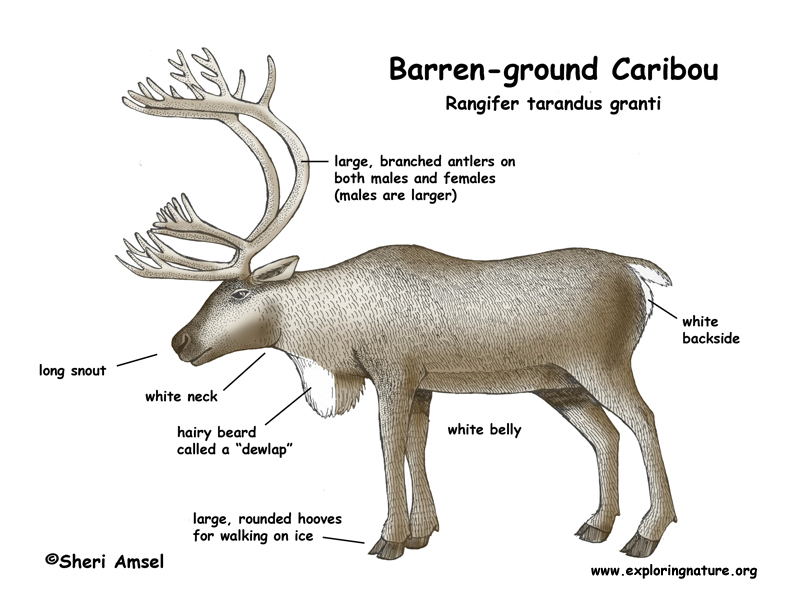
Classification
- Kingdom: Animalia
- Phylum: Chordata
- Subphylum: Vertebrata
- Class: Mammalia
- Order: Artiodactyla
- Family: Cervidae
- Subfamily: Capreolinae
- Genus: Rangifer
- Species: Rangifer tarandus