

Rupicapra rupicapra
Range
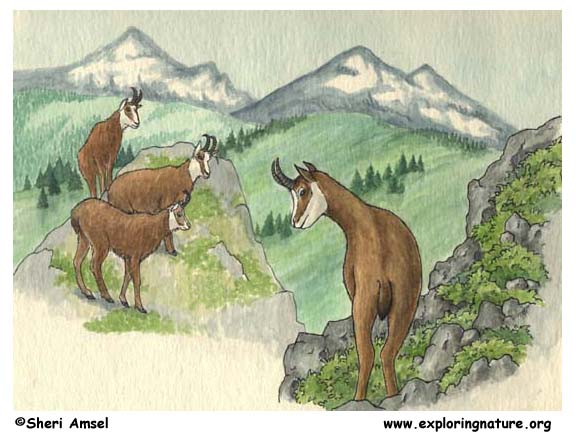
They are found in the Alps of Europe and Asia.Habitat
They live in high mountain grassy areas.Body Traits
They can reach 4-feet long (130 cm) and weigh up to 140 pounds (62 kg). They have a reddish-brown coat that gets longer and darker in winter. Their faces are distinct with a white strip that runs from their nose back and a white patch that covers their cheeks and throat. A dark strike runs around the eyes from nose to ears. Both males and females have dark, thin horns that curve back at the ends.Habits
They live high in the mountain in summer, staying in grassy areas at about 6,000 feet. In the winter they come down lower, even into forested areas, using steep cliffs to escape predators. They are amazing climbers, able to leap across 20-foot spans (6m). They can run 30mph (50kmh). Males usually live alone, while females live in flocks with young.Diet
They eat grass mostly but will take leaves, buds and mushrooms.Predators
They are hunted by lynx, wolves, and bears. Young are killed by foxes and large birds of prey.Reproduction
Males compete for females in the fall “rut.” Females are pregnant for 5.5 months (gestation) and have 1-2 young in late spring. Babies can climb to safety with their mothers very soon after birth.Lifespan and/or Conservation Status
They can live more than 20 years in the wild. They are listed as Lower Risk – conservation dependent in much of their European range, but endangered in some mountainous regions where they are heavily hunted for food and there is habitat loss.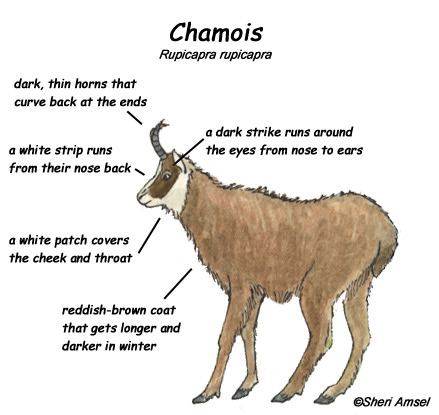
Classification
- Kingdom: Animalia
- Phylum: Chordata
- Subphylum: Vertebrata
- Class: Mammalia
- Order: Artiodactyla
- Family: Bovidae
- Subfamily: Caprinae
- Genus: Rupicapra
- Species: Rupicapra rupicapra