

Inia geoffrensis

Range
They are found in northern South America in the counties with tributaries of the Amazon River – Brazil, Columbia, Peru, Venezuela, Ecuador and Bolivia.Habitat
They live in freshwater rivers including the Amazon River, its tributaries and other connected rivers in the Amazon Basin. During the rainy season, dolphins may actually swim up into the flooded forest.Body Traits
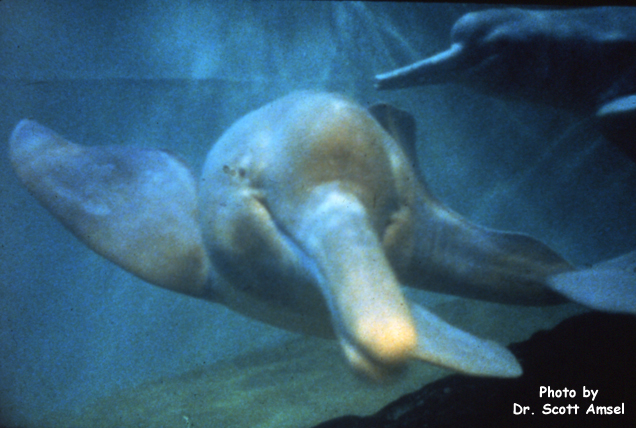
They are born gray but they turn pink as they age, especially underneath. Males are pinker than females. They can reach 8 feet (2.5m) long and weigh up to 440 pounds (200 kg). Females are smaller. They are physically well adapted for life in the river with wide, flexible flippers (pectoral fins) and tail (flukes), a rectangular dorsal fin and a very flexible neck. They are not sleek and streamlined for speed like many ocean species of dolphin, but are rather chunky with a rounded head (sometimes called the melon). These features might limit their speed, which could endanger them in the open ocean, but helps them move in the tight spaces of the river and flooded forest. They use a clicking radar, called echolocation, to navigate the Amazon’s dark waters.Habits
They live mostly alone (solitary) except when breeding and females with young. Males can be aggressive toward each other and will fight using their many sharp teeth. In contrast, they can be curious and even playfully approach boats on the river.Diet
They eat fish, turtles, and crabs.Predators
They can be attacked by caimans, anacondas, and even jaguars.Reproduction
Females are pregnant for 11 months (gestation) and have one 15-pound calf. They will nurse them for a year and the calf will stay with their mother for another year or more after weaning before going out on their own.Lifespan and/or Conservation Status
No one really knows how long they live in the wild, but a few captive pink dolphins have lived for more than 25 years. Most captives live considerably less. They are listed as vulnerable by the IUCN Red List.
Classification
- Kingdom: Animalia
- Phylum: Chordata
- Subphylum: Vertebrata
- Class: Mammalia
- Order: Cetacea
- Suborder: Odontoceti
- Family: Iniidae
- Genus: Inia
- Species: I. geoffrensis