

Mesocricetus auratus

Range
Wild golden hamsters are from the Middle East.Habitat
They live in burrows on grassy steppes and farmland in their wild range, but are found all over the world in captivity.Body Traits
They weigh up to 4.5 ounces (125 g) and can reach more than 5” long. They have a rounded face, small eyes, large rounded ears, and a short, half-inch (1.5 cm) tail. Their fur is orange-brown on top and whitish below. Some have different markings on their fur that make them stand out, like patches or stripes of brown on the face or neck.Habits
They live alone (solitary) except when mating or raising young. They are active at night (nocturnal) and sleep all day. They are territorial and will rub against things to spread their oily scent and ”mark” their territory. During cold times they will sleep deeply for many days. This is called torpor.Diet
They eat plant and animal matter (omnivorous) like grass, seeds, nuts, and insects.Reproduction
Females are pregnant for just over 2 weeks (gestation). They will have up to 12 young for which they care and nurse for about 3 weeks. The new babies can start having babies of their own about a month after they are born! Females have litters all through the warm season and care for the young themselves.Lifespan and/or Conservation Status
They only live about 2 years and longer in captivity.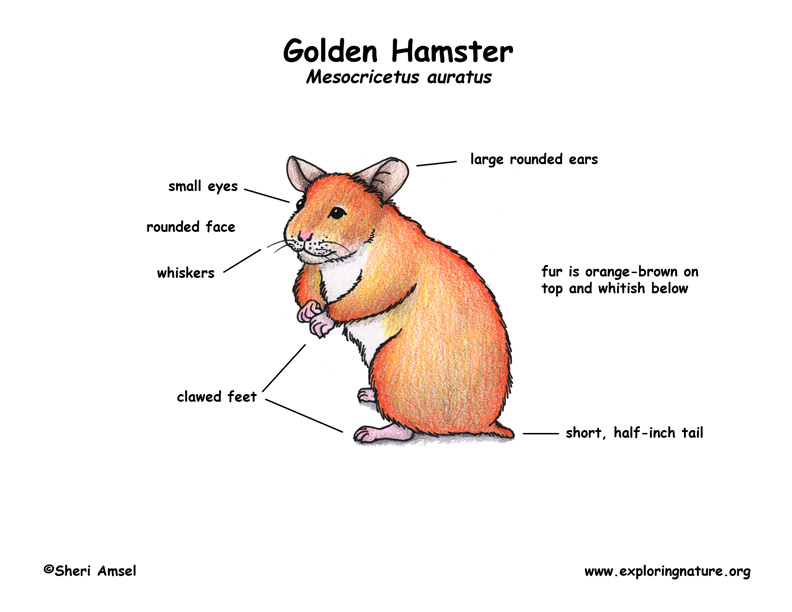
Classification
- Kingdom: Animalia
- Phylum: Chordata
- Subphylum: Vertebrata
- Class: Mammalia
- Order: Rodentia
- Suborder: Myomorpha
- Family: Cricetidae
- Subfamily: Cricetinae
- Genus: Mesocricetus
- Species: Mesocricetus auratus