

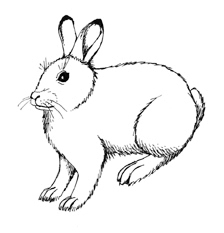
Lepus arcticus
Range
They are found in northern Canada.Habitat
They live out on the tundra, in rocky areas and in the mountains.Body Traits
They are the fastest, largest hares in North America. They are grayish-brown with short, black-tipped ears. They turn white in winter (except for the black tips) to blend in. Furthest north, they stay white year round. They have long claws for digging in the snow to get to grass buried underneath.Habits
They are active at night (nocturnal). They gather to feed in groups of up to 60 hares.Diet
They eat twigs, roots, tough, green sedges, moss and berries.Predators
They are hunted by wolves, lynx and fox.Reproduction
Males fight over females by hitting each other with their front feet (boxing). Females are pregnant for about 7 weeks (gestation). They have 2-8 babies hidden in bushes or rocks. Babies very quickly (within just a day or two) know to keep still and blend in to hide from predators.Lifespan and/or Conservation Status
They live about 2 years in the wild. They are listed as Lower Risk – least concern.
Classification
- Kingdom: Animalia
- Phylum: Chordata
- Subphylum: Vertebrata
- Class: Mammalia
- Order: Lagomorpha
- Family: Leporidae
- Genus: Lepus
- Species: Lepus arcticus