

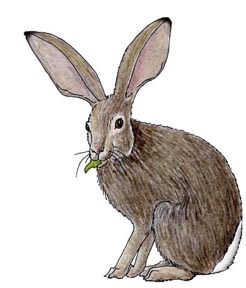
Lepus townsendii
Range
They are found in mid to western Canada and the U.S. south to central California and Kansas.
Habitat
They live in grassy fields, prairies, desert scrubland and farmland.
Body Traits
They are light gray, lighter below. They get lighter in color in the winter. Their tail is all light colored. They have long ears with darker tips. They have large back feet for leaping. They can grow to be big — weighing up to 9 pounds (4kg).
Habits
They are active at night (nocturnal) and live alone (expect during mating season). A very fast animal, they can leap along at more than 30 mph (48 km/h).
Diet
They eat plants – grass, and shrubs.
Predators
They are eaten by hawks, coyotes, foxes, bobcats, badgers and weasels.
Reproduction
Females are pregnant (gestation) for about 6 weeks and have 5 or more young in a small hollow right on the ground, often lining it with their own fur. Young are more mature at birth than cottontail rabbits with body fur and eyes open. They are feeding on plants within a couple of weeks and completely on their own in little more than a month. In warmer climates females may have many litters in one year, though fewer in harsher climates.
Lifespan and/or Conservation Status
They can live 6-8 years in the wild, but usually much shorter. They are listed as Lower Risk – least concern.

Classification
Kingdom: Animalia
Phylum: Chordata
Subphylum: Vertebrata
Class: Mammalia
Order: Lagomorpha
Family: Leporidae
Genus: Lepus
Species: Lepus townsendii