

Dipodomys ordii
Range
They are found in the western U.S., Canada and Mexico. They may be found in the largest range and are the most common of all the kangaroo rats in their habitats.Habitat
They live in dry, sandy grasslands, desert, and open scrubby areas where they can move about easily. They burrow in sandy soil.Body Traits
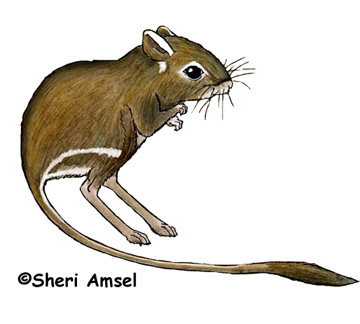
They are golden, brown on top with white markings and lighter under parts. They have a white line across the hips, a white spot at the base of the ears and over the eyes, along the edge of the ears and on the tip of the snout. They can have darker hairs on the back and a dark line down the sides of their snout. They can reach 14” long, their tail being about 5” of that length, but are often smaller. Males are slightly bigger than females but they look the same. The long tail is bi-colored (dark on top, lighter on bottom and sides) with a tuft of dark hair at the end. They have large back legs for leaping (saltatory locomotion) and smaller front feet for handling food. They have 5 toes with sharp nails for digging.Habits
They are active at night (nocturnal) collecting food, but never go very far from their burrow. If threatened they jump away, moving in a fast, but unpredictable way to escape predators. They also have been seen kicking sand back behind them to blind predators. They live alone, except while mating or a female with young. During the day they rest in their burrow, the opening blocked with sand to protect from predators and the heat of the day.Diet
They eat mostly seeds. They may also eat leaves, buds, and insects when they are available. They gather seeds into their pouch and carry them back to their burrow to feed in a safer place. They can survive drinking water only rarely and get the moisture they need from the foods they eat.Predators
They are killed by coyotes, owls, snakes, badgers, bobcats, and weasels.Reproduction
Females are pregnant for about a month (gestation) and have about 3 young in her burrow. She cares for them for about 2 months until they can go out on their own. They only have young if there is enough rain to produce food. If there is enough food around they will have two litters a year in spring and fall.Lifespan and/or Conservation Status
They rarely live more than a year in the wild. They are listed as Lower Risk – least concern.
Classification
- Kingdom: Animalia
- Phylum: Chordata
- Subphylum: Vertebrata
- Class: Mammalia
- Order: Rodentia
- Suborder: Castorimorpha
- Family: Heteromyidae
- Subfamily: Dipodomyinae
- Genus: Dipodomys
- Species: Dipodomys ordii