

Panthera leo
Range
They are found in Africa.
Habitat
They live on the African savanna and veldt (grasslands) and in open woodlands on the edge of the grasslands.
Body Traits
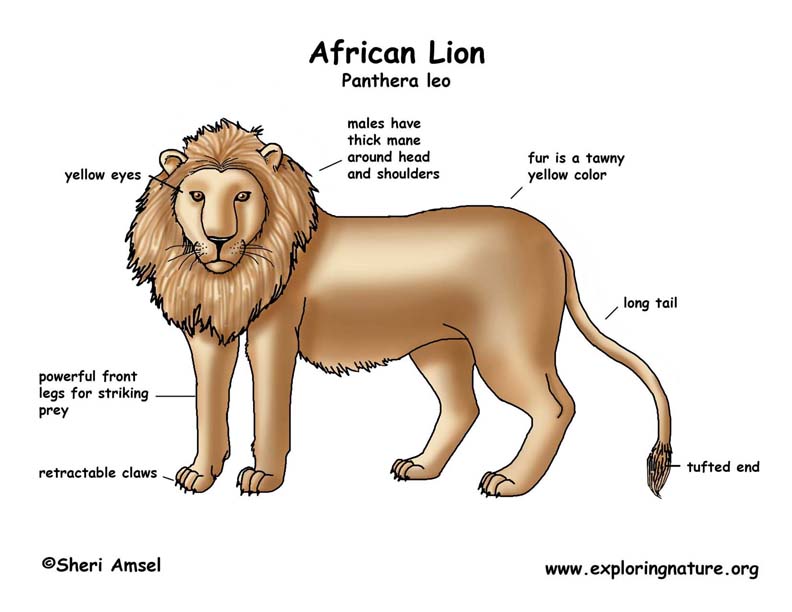
Males can be up to 11 feet long with tail (about 8 feet without tail) and weigh up to 550 pounds. Males have a mane around the face and neck that can be tan to dark brown in color. Females can be up to about 9 feet with tail (and 6 feet without) and weigh up to 400 pounds. Adults are tan to light brown in color with no markings or spots.
Habits
They live in large family groups of 20 or more lions called prides. Every pride usually has 2 males and many related females with their young. The females stay together for life. The males compete with each other for control of their pride. Once a male gets too old to fight for his pride, he loses it to a younger, stronger male. This keeps the more fit males as father to the new young.
Diet
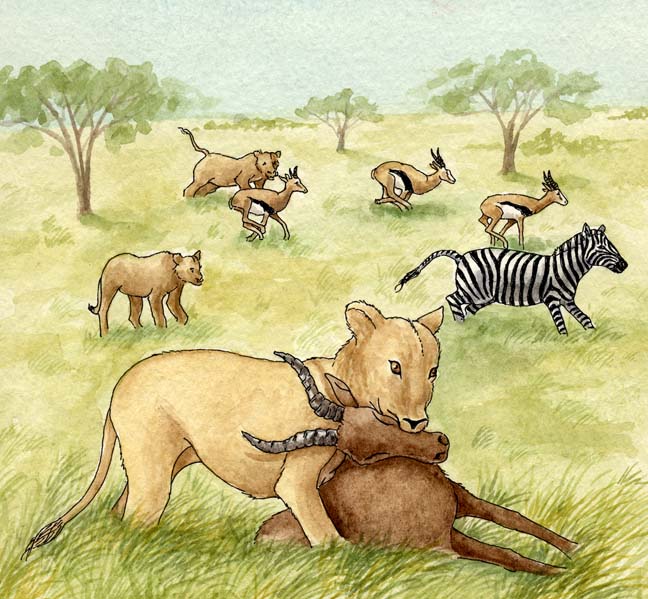
They eat wildebeest, zebra, giraffes, gazelles, cape buffalo and young elephants, rhinoceros and hippopotamus.
Predators
Their only predator is man. Young cubs may be killed by a new male taking over the pride.
Reproduction
Females are pregnant for about 4 months (gestation). They have 1-6 cubs. Only half the cubs survive to adulthood. The females will have cubs every 1.5 to 2 years.
Lifespan and/or Conservation Status
Males live in the wild up to16 years, females live up to18 years. They are listed as a “vulnerable” species.
Classification
- Kingdom: Animalia
- Phylum: Chordata
- Subphylum: Vertebrata
- Class: Mammalia
- Order: Carnivora
- Suborder: Feliformia
- Family: Felidae
- Subfamily: Pantherinae
- Genus: Panthera
- Species: Panthera leo