

Trichechus manatus
Range
They are rare in most of their range throughout the world. The Florida Manatee is found along the southeastern coastlines from Virginia down to Florida, along the Gulf Coast and in Central and South America.
Habitat
They are found in warm waters (68°F or higher) where sea grasses grow along coastlines, in slow moving rivers, where ocean tides meet rivers (estuaries), and in bays. In North America they are mostly found in Florida. In the summer they sometimes wander up the coastlines as far as Virginia.
Body Traits
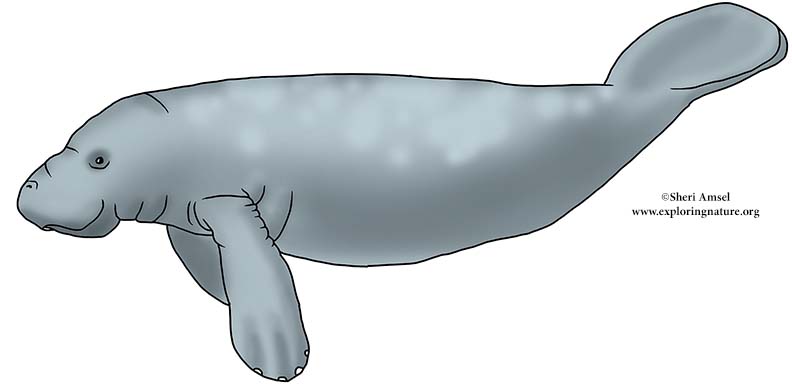
Gray with wrinkled skin, they are very stout, weighing up to a ton (2,000 pounds or 907 kg). They can reach 14 feet long (4.26 m) with a wide, flat tail and large flippers. Some species are even larger. They have a wide snout, thick with whiskers.
Habits
They move very slowly and often nap in the water with just their nostril above the water to breathe. This habit causes them to be hit by motorboats. Scientists believe that 30% of all Florida manatee deaths every year are from these accidents. The manatees who survive boat accidents have long, terrible scars on their backs. They are very affectionate with each other and will greet by touching snouts in a “kiss” and hug using their flippers. Their nipples for nursing are under their flippers, so nursing young are cradled against their chest, like a human baby. They like warmer waters so in cold weather have been found in groups of 200 crowded around the warm water released from power plants.
Diet
They are the only marine mammal that is a vegetarian, feeding on sea grasses, plants and mangroves. Because of their grazing habits they are sometimes called “sea cows.” They eat up to 150 pounds (70 kg) of plants per day. They help keep waterways free from weeds.
Predators
They move very slowly and have no defenses against attack. Despite this, they have few predators except man. Babies are preyed upon by sharks and alligators.
Reproduction
Females are pregnant for 12-13 months (gestation). They only have 1 young every 2-3 years. Babies weigh up to 60 pounds at birth.
Lifespan and/or Conservation Status
They can live up to 70 years. They are listed as vulnerable on the CITES List (International List) and endangered on the U.S. Federal Endangered Species List.

Classification
Kingdom: Animalia
Phylum: Chordata
Subphylum: Vertebrata
Class: Mammalia
Order: Sirenia
Family: Trichechidae
Genus: Trichechus
Species: Trichechus manatus