

Suricata suricatta

Range
They are found in Africa.Habitat
They live on dry grasslands.Body Traits
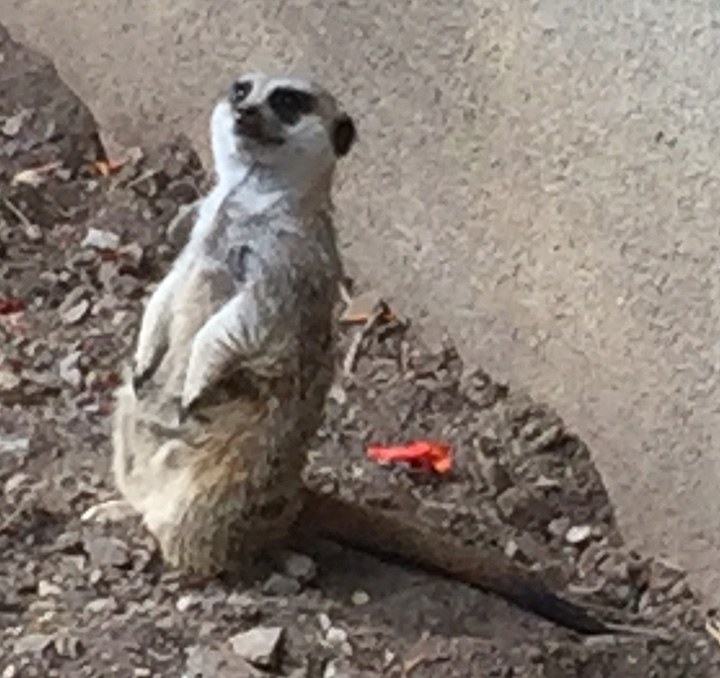
They are long, slender mammals reaching about 2 feet including the tail and weighing up to about 1.5 pounds. They are grayish-tan colored with some dark bands across the back. They have a long, thin tail with a black tip. They have a pointed face with dark eyes and small, dark ears. Their feet have sharp claws for digging.Habits
They are active during the day (diurnal), living in social groups of up to 30 animals in underground burrows. These groups, called packs, are made up of many family groups, each with a mated pair (father and mother) and many offspring (kits). They find safety in numbers and take turns posting sentries that watch for danger. If danger approaches, they bark an alarm call to warn the others.Diet
They eat mostly insects, but also some spiders and other invertebrates, like centipedes. They will also eat small lizards and birds.Predators
They are killed by snakes, hawks, eagles and jackals.Reproduction
Females are pregnant for 11 weeks (gestation) and have an average of 3 babies. They nurse for up to 2 months. Babies are often cared for by their fathers and other non-breeding members of the pack while the mother feeds.Lifespan and/or Conservation Status
They can live for more than 10 years in the wild but face many dangers, like poisonous snakes, that result in much shorter lives. They are Lower Risk – Least Concern on the IUCN List.
Classification
- Kingdom: Animalia
- Phylum: Chordata
- Subphylum: Vertebrata
- Class: Mammalia
- Order: Carnivora
- Suborder: Feliformia
- Family: Herpestidae
- Genus: Suricata
- Species: S. suricatta