

Oreamnos americanus
Range
They are found from southeastern Alaska down through the Canadian Rockies and into Montana, Colorado, and Washington.Habitat
They live in high mountain areas with cliffs and steep rock up which they escape predators.Body Traits
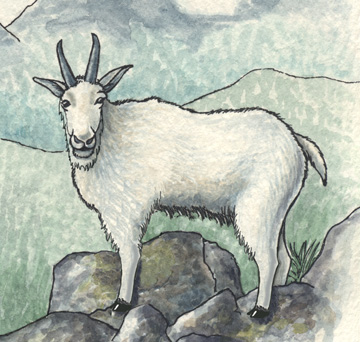
They have long, thick, white coats. Both sexes have long, thick, black horns. They have large, rounded hooves with thick pads that help them grip the rocks as they travel. The males are larger reaching 185 pounds and almost 6 feet long.Habits
They live in herds in the winter, spreading out in the spring. They are often found alone in summer, or a female with young. During mating season the males fight over females by stabbing at each other with pointed horns.Diet
They eat plants in their habitat, including grass, moss, lichens, wildflowers and shrubs.Predators
Wolves, mountain lions, and eagles can kill kids and will sometimes take adults.Reproduction
Females are pregnant for up to 6 months (gestation). They have 1-3 kids by June. The kids can climb on rocks almost right after they are born. This is important to protect themselves from predators. Females will find a very steep, rocky place to give birth to avoid predators.Lifespan and/or Conservation Status
They live up to 15 years in the wild. They are listed as Lower Risk – least concern.
Classification
- Kingdom: Animalia
- Phylum: Chordata
- Subphylum: Vertebrata
- Class: Mammalia
- Order: Artiodactyla
- Family: Bovidae
- Subfamily: Caprinae
- Genus: Oreamnos
- Species: Oreamnos americanus