

Pongo pygmaeus
Range
Orangutans live in Asia on the islands of Sumatra and Borneo.
Habitat
They live in tropical rainforests up in the trees (arboreal).
Body Traits
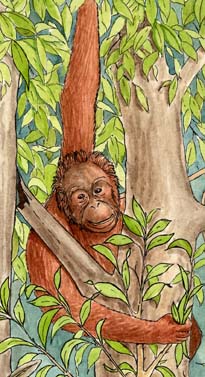
Orangutans are covered with long reddish hair. They have thick necks, long arms and no tail. Males weigh about 200 pounds and have large cheek pouches. Females are about half the size of males. Orangutans have thumbs and can grasp with their hands like a human, but also can grasp with their feet the same way. This is important for how they travel, which is swinging from tree to tree (brachiating) high up above the ground. The width of their outstretched arms (arm span) can be 7.5 feet!
Habits
Orangutans are shy, and live alone, active during the day (diurnal). Orangutans are smart and like chimpanzees use things they find as tools.
Diet
Orangutans can eat both plants and meat (omnivores) but eat mostly fruit, leaves, seeds, tree bark, plants, bulbs, and flowers. They can eat insects and small animals.
Predators
Predators are leopards, poisonous snakes and man.
Reproduction
Females are pregnant for 8.5 to 9 months (gestation) and give birth to a single baby.
Lifespan and/or Conservation Status
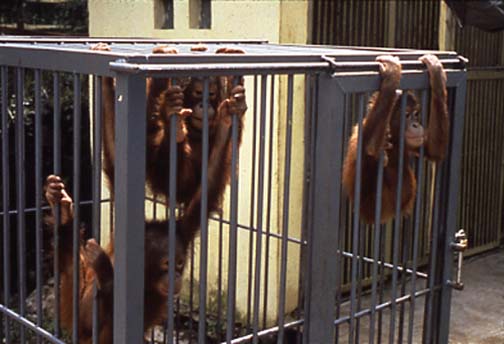
Orangutans can live 30-45 years in the wild and have been known to live into their 50s in captivity. Orangutans are endangered.

Classification
Kingdom: Animalia
Phylum: Chordata
Subphylum: Vertebrata
Class: Mammalia
Order: Primates
Suborder: Haplorrhini
Family: Hominidae
Genus: Pongo
Species: Pongo pygmaeus