

Erethizon dorsatum
Range
Porcupines can be found across Canada and in the U.S., throughout Alaska, the western U.S., the Northeastern states and the Great Lakes region.
Habitat
They live in forests and desert regions.
Body Traits
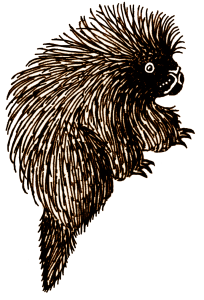
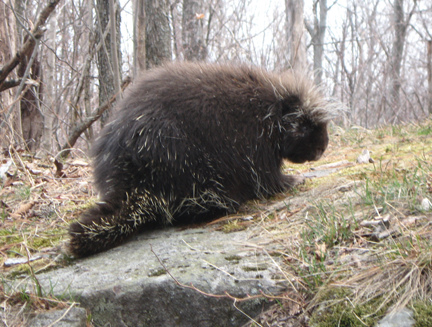
The second largest of all rodents in the U.S., the porcupine has a small head, a large, rounded body and a long, thick, muscular tail. They can grow to 4 feet long including their tail and weigh up to 40 pounds. Their bodies are covered with stiff guard hairs and a band of sharp quills that runs down the center of the back (dorsally) from the head to the tip of the tail.
The quills are a good defense because they each sit in a casing that lets them to pull out easily when a predator touches them. Each quill has a pointed end with a tiny barb, like a fishhook. When a quill sticks into an animal’s skin, it does not pull out easily. As the predator’s muscles work, the quills get pulled in further, embedding painfully.
Check out the Adaptations of the Porcupine.
Habits
The porcupine is active at night (nocturnal) though can be seen out during the day. They are good climbers (arboreal). When a porcupine is attacked by a predator, it will turn its back and raise its quills to make them point toward the predator’s face.
Diet
They are herbivores feeding on leaves, twigs, green plants and tree bark in the winter.
Predators
Predators are coyote, mountain lion and fisher.
Reproduction
Females are pregnant for 4-5 weeks (gestation) having 1-2 babies.
Lifespan and/or Conservation Status
They can live 5 to 6 years in the wild. They are listed as Lower Risk – least concern.

Classification
- Kingdom: Animalia
- Phylum: Chordata
- Subphylum: Vertebrata
- Class: Mammalia
- Order: Rodentia
- Suborder: Hystricomorpha
- Family: Erethizontidae
- Subfamily: Erethizontinae
- Genus: Erethizon
- Species: Erethizon dorsatum