

Bassariscus astutus

Range
They are found in scattered pockets across the U.S. where their habitat remains undeveloped. Populations of ringtails have been identified in Oregon south through California to Baja, across the southwest (Nevada, Utah, Colorado, Arizona, New Mexico, and Texas), the mid-west in Kansas, Oklahoma and Ohio, the south (Arkansas, Louisiana, Alabama) and into northern Mexico.Habitat
They live around rock outcroppings in dry forests, rocky canyons, deserts, and scrublands.Body Traits
They have some similar traits to raccoons (they are in the same family), but are much more cat-like in their body-shape. They are also smaller than raccoons, only weighing up to 3 pounds. They are brown on top and lighter beneath. They have a very pointed face and large, rounded ears. They reach almost 3 feet (90 cm) long including the tail, which accounts for more than half of their length. The tail is ringed in black and white like a raccoon’s, but much longer and bushier. Their eyes are ringed in dark fur and with an outer ring of white. They have sharp teeth and claws. They have padded feet and the back feet can rotate around allowing them to climb headfirst down vertical rock faces with their back claws turned up and gripping.Habits
They are active at night (nocturnal) and live alone (solitary) except when breeding. They are agile climbers and in their rocky habitats have been seen leaping from ledge to ledge, wedging themselves up through narrow rocky chimneys or scrambling down walls head first. They spend a lot of time grooming their fur and sitting upright like a cat. They have many calls and have startled campers with their piercing screams in the middle of the night. When threatened, they puff out the long tail and arch it back over their head. They can also give off a skunk-like odor and screech loudly.Diet
They are carnivores with an omnivorous diet – eating whatever they can find. They prefer to eat small animals like mice, squirrels, rabbits, birds, lizards, frogs, snakes, insects and even dead animals (carrion). They also eat fruits, seeds, nuts, grain, and even flower nectar.Predators
They are killed by coyotes, bobcats, great horned owls and man.Reproduction
Females are pregnant for 7.5 weeks (gestation) and have up to 4 tiny (1-ounce) young in the spring. They have their litter in a den in a hollow tree or protected in a pile of rocks and nurse them for about 2.5 months. The females are the main caretakers of the young.Lifespan and/or Conservation Status
They can live about 7 years in the wild and longer in captivity.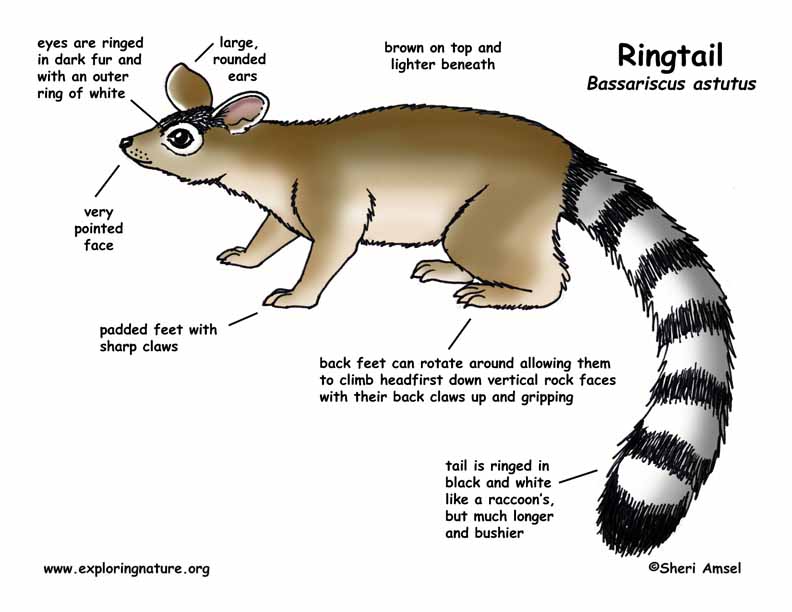
Classification
- Kingdom: Animalia
- Phylum: Chordata
- Subphylum: Vertebrata
- Class: Mammalia
- Order: Carnivora
- Suborder: Caniformia
- Family: Procyonidae
- Genus: Bassariscus
- Species: B. astutus