

Lobodon carcinophagus
Range
They are found in the Ocean along the coastlines of Antarctica. In the winter they can be found off the coasts of South America, Australia, South Africa, Tasmania, and New Zealand.Habitat
They live along the coast and pack ice of Antarctica and in the winter months along coastal shores further north.Body Traits
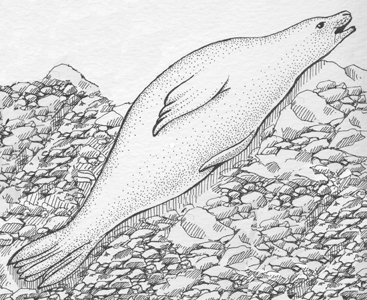
They are 8.5ft long and weigh up to 650 pounds. In the winter they are darker colored with a lighter belly and dark flippers. In the summer they are lighter to a sandy color. They often have long scars running down the sides of its body from predator attacks. Their teeth are unusual. They are shaped to fit close together with tiny spaces so that when they take a mouthful of krill, they can push the water out through the holes like a strainer.Habits
They live alone but do sometimes gather into a large group of hundreds of seals. They travel north and south with the seasons (migrate). They dive and stay underwater for a long time while feeding or migrating. They are fast swimmers and deep divers, reaching 90 feet in search of food. They will bare their teeth and hiss when they feel threatened.Diet
They eat mostly krill.Predators
They are hunted by killer whales and leopard seals.Reproduction
Females are pregnant for 11 months (gestation). They have 1 baby (pup) out on the ice floe. They nurse the pup for about 3 weeks. A male Crabeater seal, usually not the father, will join the female just before or just after she gives birth to protect the mother and her pup. Soon after weaning, females are ready to breed again, and, although her protective male defends her from the aggression of other males, he is typically aggressive toward the female during the nursing period.Lifespan and/or Conservation Status
They can live 40 years. They are listed as Lower Risk – least concern.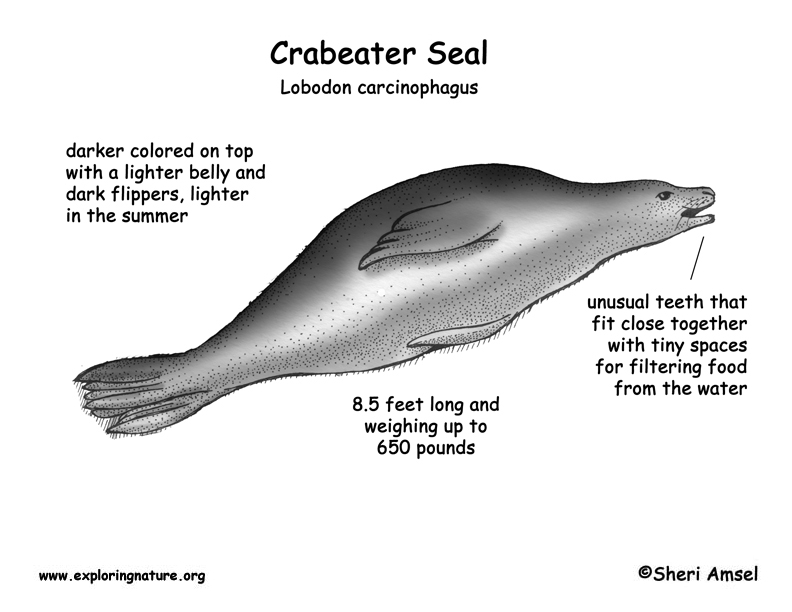
Classification
- Kingdom: Animalia
- Phylum: Chordata
- Subphylum: Vertebrata
- Class: Mammalia
- Order: Carnivora
- Suborder: Caniformia
- Family: Phocidae
- Genus: Lobodon
- Species: Lobodon carcinophaga