

Sorex dispar
Range
They are found in mountainous areas along the Atlantic coast from southern Canada down through the eastern U.S. to the Appalachian mountains and as far south as Georgia.Habitat
They live in the leaf litter and rocky debris along streams and on scree slopes in cool mountain forests, often at high altitudes.Body Traits
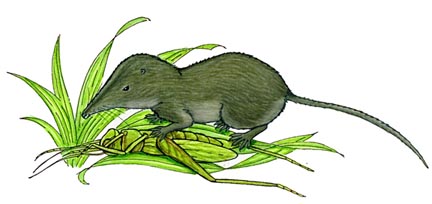
They are slate gray on top and lighter below. They have a pointed face with small eyes and ears. They have a long tail. They reach up to about 4 inches (10cm) long including the tail and weigh less than ¼ ounce (7g). They have scent glands that give off a strong musky smell, probably to discourage predators.Habits
They are active day and night all year round foraging for enough food to maintain their tiny bodies. They need to eat twice their body weight every day. They live alone (solitary) except when breeding. They are territorial and will attack other shrews that they come across.Diet
They eat insects, spiders, centipedes and some plant matter.Predators
They are killed by hawks, owls, weasels and snakes.Reproduction
Females have several litters from April to August, each having up to 7 young. They are born in a nest of grass and leaves hidden under rocks or in tunnels under the leaf litter. They nurse for 4-5 weeks.Lifespan and/or Conservation Status
They can live up to 2 years in the wild. They are listed as Lower Risk – Least Concern on the IUCN Red List.
Classification
- Kingdom: Animalia
- Phylum: Chordata
- Subphylum: Vertebrata
- Class: Mammalia
- Order: Soricomorpha
- Family: Soricidae
- Genus: Sorex
- Species: S. dispar