

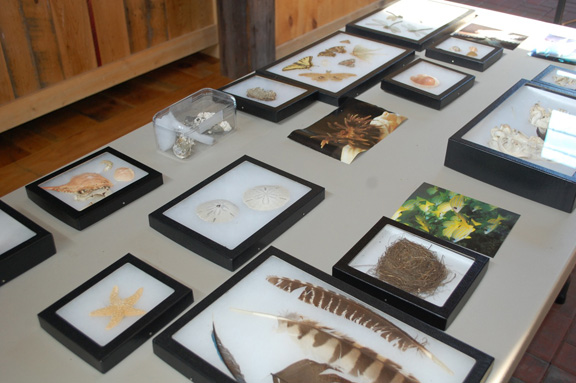
Understanding the classification of animals is an important building block of science education, yet most adults cannot tell you how to group the most common animals. Developing a classification collection with students helps to familiarize them with the classification hierarchy and how things fit into the system. This activity should follow your lecture and reading on animal classification to reinforce what they have learned.
Combine this with a spring time nature walk in the forest or along a shoreline and collect things to add to your display – dead insects, feathers, shells, etc.
Age: This suits older students who are learning classification in life science and biology.
Materials:
1. Collect 10-15 plastic clam shells* (in which you buy strawberries or salad greens).
2. Start a collection of animal “parts.” This can include old seashells, a shark’s tooth, snail shell, sand dollar, dead spider or insect (fly or ladybug), feather, egg shell, piece of a wasp nest, bird nest, rattlesnake rattle, feather, antler, skull, porcupine quill, starfish, old wasp nest, etc.
3. If you cannot put together a real collection, you can use magazine pictures (or even a fake collection with plastic animals). Either works the same way, though may not be quite as compelling as a real collection.
4. Print out and laminate enough animal classification sheets for each pair of students.
Procedure:
1. Put one animal example in each clam shell.
2. Lay them out on the table numbered and provide a numbered answer sheet.
3. Ask students to study the animals’ characteristics and use the classification sheet to identify in which class, subphyla (if applicable) and phylum each it belongs.
5. Talk about their answers.
6. Talk to them about other animals they have seen while visiting the beach, desert, forest, etc. (i.e. jellyfish, tick, slug, etc.)
Supplemental Questions:
You can spur them on to think about each animals’ characteristics with 10 simple questions. Here are our suggestions, but you may want to write a few of your own.
1. Does this specimen represent an animal that has a backbone (Phylum Chordata)?
2. Does this specimen represent an animal that has an exoskeleton (Phylum Arthropoda)?
3. Does this specimen represent an animal that is worm-shaped and segmented (Phylum Annelida)?
4. Does this specimen represent an ocean animal that consumes food though an opening underneath it and has a symmetrical body shape (Phyla Echinoderm or Cnidaria)?
5. Does this specimen represent an animal that is soft-bodied but lives inside a shell or has a defensive beak (Phylum Mollusca)?
6. Does this specimen represent an animal that has 6 legs or more? (Class Insecta or Arachnid or SubPhylum Crustacean, etc.)?
7. Does this specimen represent an animal that has feathers, a shell, scales, fins, etc. (Class Aves, Reptilia, Bony Fish, Cartilagenous Fish)?
8. Does this specimen represent an animal that has a backbone, is warm-blooded and has fur (Class Mammalia)?
9. Does this specimen represent an animal that has a backbone and lays eggs in the water (Class Amphibia)?
10. Does this specimen represent an animal that has two matching shells or one spiral shell (Class Bivalve vs. Gastropoda)?
Additional Activity:
1. Ask students to bring in pictures of animals and try to stump the class with their classification. They will bring everything from sea slugs to sea cucmbers, so be prepared!
* Reusing plastic containers (that would have been thrown out) makes this a green activity. Combining reuse of materials with educational enhancement – win-win!
