

Glaucomys sabrinus
Range
Northern flying squirrels are found in Canada, the northern United States down into the Appalachian Mountains.Habitat
They live in conifer or mixed forests.Body Traits
Though they can grow to be 14-inches long, they only weigh about 5 ounces making them the smallest of all the squirrels. They are gray to brown, with a flat tail, large eyes and loose skin flaps that go from their wrists to ankle along their sides.Habits
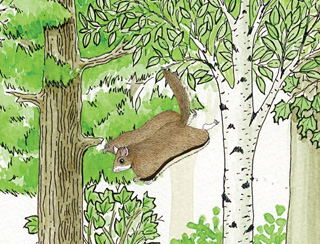
Flying squirrels don’t really fly, but glide with outstretched arms and legs, the flap of skin held out like a sail. In this way they can move up high in the treetops and sail 100 feet at a time if they need to. The are the only squirrel active at night (nocturnal), so few people see them gliding. They nest in trees and spend the winter in torpor. They are not true hibernators.Diet
Flying squirrels eat nuts, berries, buds, and flowers. They may also eat insects, bird eggs, or even a bird nestling itself.Predators
Predators include owls, hawks, martens, weasels, coyotes, and house cats.Reproduction
Flying squirrels have only one mate at a time (monogamous), but may have a new mate the next year. Females are pregnant for about 40 days (gestation) and have 3-6 young.Lifespan and/or Conservation Status
They can live 5-6 years in the wild. They are listed as Lower Risk – least concern on the CITES List (International List) and endangered on the U.S. Federal Endangered Species List in some regions.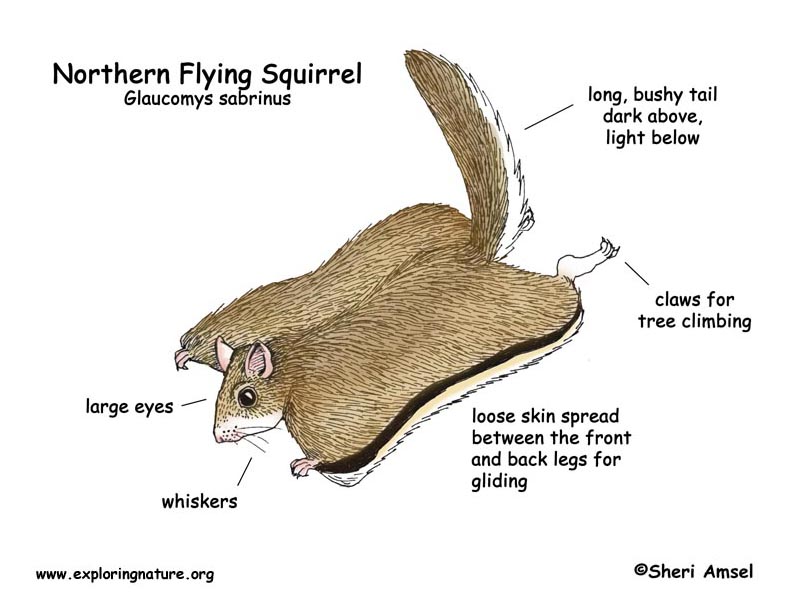
Classification
- Kingdom: Animalia
- Phylum: Chordata
- Subphylum: Vertebrata
- Class: Mammalia
- Order: Rodentia
- Suborder: Sciuromorpha
- Family: Sciuridae
- Subfamily: Sciurinae
- Genus: Glaucomys
- Species: Glaucomys sabrinus