

Tamiasciurus hudsonicus
Range
The red squirrel is found in Canada and the northern United States down to the Appalachian Mountains.Habitat
They live in coniferous, deciduous, and mixed forests.Body Traits
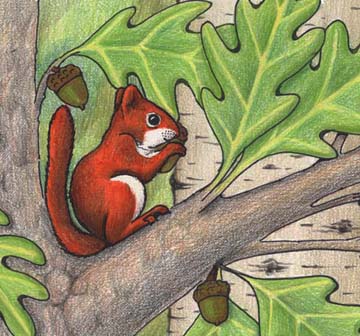
They are reddish-brown on top and have white bellies with a black stripe where the two colors come together on their sides. They have ear tufts in the winter. They are about a foot long including their tail and weigh about 8-9 ounces. Their tail is not as bushy as the gray squirrel’s tail.Habits
They are active during the day (diurnal) and all year round. They live much of their lives in the trees (arboreal).Diet
They eat pine seeds, nuts, fruit, insects, bird eggs and even small animals. Like the gray squirrel they bury seeds for later so are important tree planters and seed spreaders. They nest in tree cavities or underground in tunnels.Predators
Predators include: owls, hawks, martens, weasels, coyotes, and house cats.Reproduction
They live alone except to mate in the spring. Females are pregnant for about 5 weeks (gestation) and can have 2-6 young. They may go on to have a second litter in late summer.Lifespan and/or Conservation Status
They live for about 7 years in the wild. They are listed as Lower Risk – least concern.
Classification
- Kingdom: Animalia
- Phylum: Chordata
- Subphylum: Vertebrata
- Class: Mammalia
- Order: Rodentia
- Suborder: Sciuromorpha
- Family: Sciuridae
- Subfamily: Sciurinae
- Genus: Tamiasciurus
- Species: Tamiasciurus hudsonicus