Range
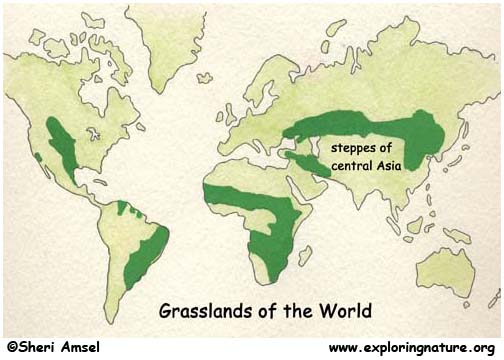
The grassland steppes of Eurasia spread from eastern China across Mongolia and Russia to Europe.
Habitat Description
The soil can be a rich, fertile black with wildflowers as far as the eye can see. A silvery sea of grass bending in the wind for much of the year, the grasslands finally turn yellow in the summer. On the steppes, it can be both fiercely cold and deathly dry. Only the fit survive.
Animals Found in This Habitat
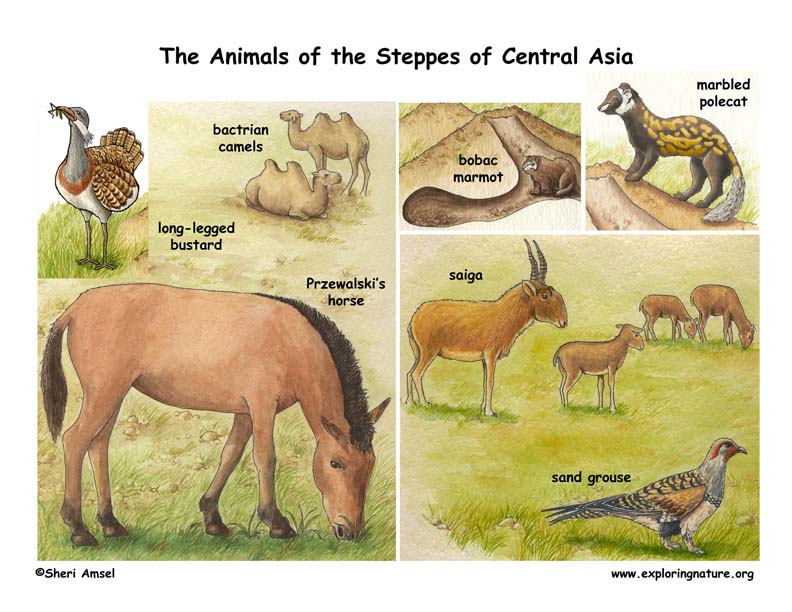
Once herds of great tan horses, named after Russian explorer Przewalski, roamed this land. But by the 1960s these horses could be found only in zoos. Another rare sight on the grassland is the wild bactrian camels. Saiga travel in herds, grazing on the rich grass. They are able to survive even in times of drought because they can go for a long time without water. The saiga can live in the severe cold because of its strange snout that warms and wets (humidifies) the air. Once numbering in the millions, like the American bison, it was hunted and killed almost to extinction. Then it was legally protected and has now grown back to safer numbers. Large colonies of sand grouse feed on grass seeds and are known to fly amazingly far in search of water. Bobak marmot burrow large communities on the steppes. Long-legged bustards run along on the ground, living on insects and small animals. They have been over-hunted because they are tasty game birds and have become scarce over much of their range. The marbled polecat searches burrows for rodents to eat. Very much like a weasel, this little meat eater can be a fierce fighter, especially if its young are in danger.
Plants Found in This Habitat
A silvery sea of tufted grasses, wild tulips, irises, and steppe thistle, blue sage, camel’s grass, and poppies all sprinkle the plain.