

Budorcas taxicolor
Range
They are found in Eastern Tibet, Sikkim, Bhutan, northern Assam, northern Burma, and central and southern China.Habitat
They live in the grassy valleys, rocky hillsides, and dense forests of the Himalayas at high elevations of up to 14,000 feet (4250 m).Body Traits
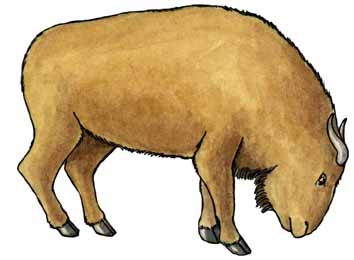
They are very large animals reaching 7-feet long and weighing up to more than 850 pounds (400 kg). Females are smaller. Their light yellow coats are long and shaggy with a dark line down the back. They have short legs with large split hooves. Their 2-foot long horns are lightly ringed and curve out, back and up in a graceful arc. Both males and females have horns. They have a rounded snout with large nostrils.Habits
They live in small herds of females and young. In the summer, many herds will come together into large groups of several hundred at higher elevations where food is abundant. Adult males live alone except during breeding season. They are active during the day (diurnal) moving slowly through thick, brushy areas on narrow trails. If threatened, they lie down in thick undergrowth, but can also climb rocks to escape danger. They have a coughing alarm call to alert others to take cover in the thick brush.Diet
They eat plants, preferring to browse on leaves, buds and shoots, but also eating grass in the summer and twigs and evergreen needles in the winter.Predators
They are killed by wolves, bears and man.Reproduction
Female are pregnant for about 7 months (gestation) and have 1 young. Babies can walk and follow their mothers within a few days.Lifespan and/or Conservation Status
They can live up to 15 years in the wild. They are listed on the IUCN Red List as vulnerable due to hunting and habitat loss.
Classification
- Kingdom: Animalia
- Phylum: Chordata
- Subphylum: Vertebrata
- Class: Mammalia
- Order: Artiodactyla
- Family: Bovidae
- Subfamily: Caprinae
- Genus: Budorcas
- Species: B. taxicolor