

Vicugna vicugna

Range
The vicuna is found in the Andes of southern Peru, western Bolivia, northwestern Argentina, and northern Chile.Habitat
Vicunas are found on the high grasslands and plains (between 10,000 – 17,000 feet) of the Andes Mountains.Body Traits
The smallest member of the camel family, the vicuna only weighs up to 150 pounds. It has a long neck and slender body, large ears and eyes. Their thick, warm coat, is a yellowish to reddish brown above and lighter underneath. They are thought to have one of the softest coats in the world. It protects them from the extreme temperatures out on the South American grasslands (pampas). The hair on their chest is long and hangs down like a bib.Habits
Vicunas are shy and can run up to 30mph to escape predators. Vicunas live in herds of females and young with one strong male leader. They are active during the day (diurnal), feeding on the poor, tough grasses of the high plains.Diet
Their specialized digestion allows them to get every bit of nutrition out of the grass they eat. Their teeth never stop growing, so as not to get worn down by the tough grass they eat.Predators
Man has been their most dangerous predator. They were hunted almost to extinction for their soft coat. The are now protected. They do fall prey to the large predators like pumas and foxes.Reproduction
Females are pregnant for about 11 months (gestation) and give birth to 1 baby in February or March. Babies can get up and run within 15 minutes after birth.Lifespan and/or Conservation Status
Vicunas in the wild live up to 15-20 years. They are listed as Lower Risk – conservation dependent.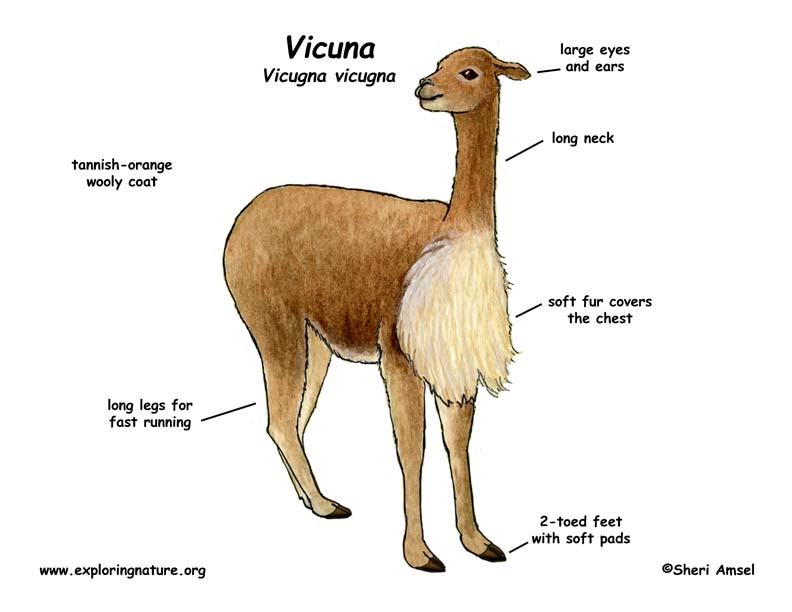
Classification
- Kingdom: Animalia
- Phylum: Chordata
- Subphylum: Vertebrata
- Class: Mammalia
- Order: Artiodactyla
- Family: Camelidae
- Genus: Vicugna
- Species: Vicugna vicugna