

Bubalus bubalis
Range
The water buffalo was once wild – roaming the forests of India and Asia. Like the Asian elephant though, the water buffalo has been domesticated for agricultural use, so is now found throughout Asia, India, Central and South America, the Mediterranean and even Australia. There are wild populations still found scattered in India, Thailand, and the surrounding countries. The domestic form is often called river buffalo or swamp buffalo and may be considered subspecies of the original wild water buffalo. The tamaraw is a smaller relative of the water buffalo found in the Philippines.
Habitat
They live in wet grasslands, along rivers, in swamps, marshes and forests – tropical and subtropical. When not feeding or resting, they wallow in the mud.
Body Traits
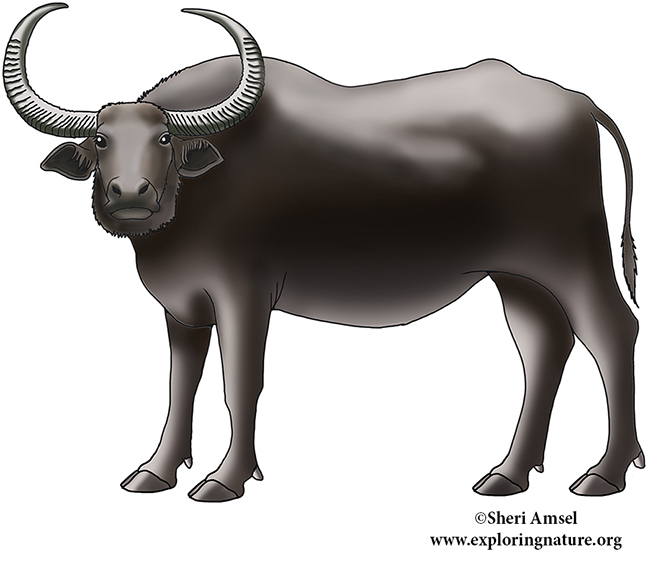
They are huge animals reaching more than 6 feet tall (1.9 m in) at the shoulder and up to almost 10 feet long. They have big heads and both males and females have large, ribbed horns that spread wide. The males’ horns are larger. The different subspecies may have different horn displays. The horns of swamp buffalo curve back and out instead of straight out. The horns of river buffalo curve in on themselves.
Males are generally much bigger than females, weighing up to 2,500 pounds (1,200 kg) to a female’s 1,700 pounds. Domesticated water buffalo are much smaller, bred to reach only about 500 – 1,200 pounds. They have large feet with hooves that spread for walking in soft mud. They are overall gray to black and generally hairless though juveniles can have scattered tufts of hair that grow quite long. They have a long tail (3 feet) that has a hair tuft at the end. They are usually always covered in mud.
Habits
In the wild, they live in groups of a dozen or more. The herds are made up of all females – females with young and females that have not yet bred. There are also young males under 3-years-old. The herd is led my one dominant female. As the young males reach maturity at 3-years-old, they leave the female herd and join smaller bachelor (non-breeding) herds. Older, breeding males live alone (solitary) and join the female herds during the breeding season only.
All water buffalo spend time wallowing in mud to keep cool and ward off biting insects. They wallow during the heat of the day or rest in the shade. Then they feed during the cooler mornings and evenings.
Diet
They are herbivores eating grass, leaves, and aquatic (water) plants. Like a domestic cow, they are ruminants. This means they have a large, multi-part stomach to digest the tough vegetation that they eat. Bacteria in the stomach’s first compartment helps to break down the plant matter and then they regurgitate it back up and re-chew it. This is called chewing the cud or ruminating.
Predators
The only predator that can really challenge a water buffalo is man, but tigers have been known to kill lone or young water buffalo. A herd of water buffalo can stand against a tiger and even kill it with their huge horns. Habitat loss is a much larger challenge for the wild water buffalo.
Reproduction
Females are pregnant for about 11 months (gestation). They have one calf (sometimes twins) and nurse them for up to 9 months. Calves weigh 75-80 pounds at birth. Males do not help care for or raise the young. They come into the female herds in the fall to mate with receptive females and leave afterward.
Lifespan and/or Conservation Status
They can live about 25 years in the wild and longer in captivity. Conservation Status: True wild water buffalo are listed as endangered under the IUCN Red List of Threatened Species because of habitat loss, hunting, interbreeding with (and disease from) domesticated animals.

Classification
Kingdom: Animalia
Phylum: Chordata
Class: Mammalia
Order: Artiodactyla
Family: Bovidae
Subfamily: Bovinae
Tribe: Bovini
Genus: Bubalus
Species: B. bubalis