

Megaptera novaeangliae
Range
Humpback whales live in the North Pacific Ocean, the North Atlantic Ocean, and the Southern Hemisphere.Habitat
They migrate seasonally, mating and giving birth (calving) in tropical waters during the winter and then going to cold polar waters during the summer to feed.Body Traits
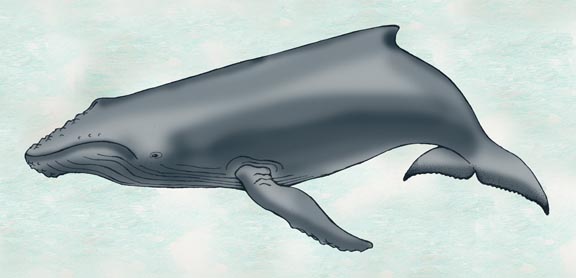
They can grow to over 50 feet long and weigh 50 tons (100,000 pounds), the females are a bit larger than the males. They have very large front flippers (the largest of any whale), about 15 feet long and covered with barnacles. Their tail (called flukes) can be about 12 feet wide. Humpbacks often jump out of the water (breaching) or pop their heads out (spying) to look around. Male humpbacks have strange and beautiful songs that they sing. Gray to black in color, humpbacks have a series of grooves running down their throats that expand when they gulp in seawater filled with food.Habits
They travel in small groups called pods swimming at 3-9 mph. They can migrate over 3,000 miles. They can dive over 700 feet deep and stay under water for more than 15 minutes, but in general humpbacks live on the surface of the ocean.Diet
Like blue whales, humpbacks are baleen whales and have no teeth, just baleen plates. They push their giant tongues against the plates and squeeze out the water leaving in the krill (tiny shrimp-like animals), fish and plankton, to eat. They can eat more than 5,000 pounds of food a day.Predators
Their only real predator is man.Reproduction
Females are pregnant for 11-12 months (gestation) and have 1 calf. Calves drink 100 pounds of milk a day.Lifespan and/or Conservation Status
Humpback whales can live 45-50 years. They are listed as vulnerable on the CITES List (International List) and endangered on the U.S. Federal Endangered Species List.
Classification
- Kingdom: Animalia
- Phylum: Chordata
- Subphylum: Vertebrata
- Class: Mammalia
- Order: Cetacea
- Suborder: Mysticeti
- Family: Balaenopteridae
- Genus: Megaptera
- Species: Megaptera novaeangliae