

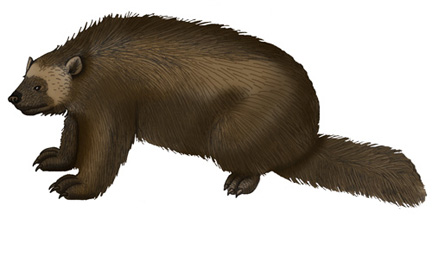
Gulo gulo
Range
They are found in northern Europe, Siberia, northern North America, Alaska, and the northwestern U.S.Habitat
They live in cold, northern (boreal) forests, in the mountains, and on the tundra.Body Traits
They are the largest member of the weasel family in North America. They are thick-bodied, weighing up to 40 pounds and reaching 3.5 feet long. They have shiny, thick, dark fur with lighter patches over their shoulders and hips. They have a large head with powerful jaws, small eyes and ears. They have strong legs and claws for digging, swimming and running! They don’t see very well but they have a great sense of smell.Habits
They are active at night (nocturnal) mostly. They live alone except to mate and will fight to defend their territory. They are fierce animals. They will scare off bears, mountain lions and wolves from their food.Diet
They eat rodents, deer, moose, elk and bighorn sheep (carnivores). They also find (scavenge) dead animals (carrion) and eggs, roots and berries. They sometimes store food to eat later.Predators
Their only real predators are large bears, wolf packs and man.Reproduction
Females are pregnant for 1-2 months (gestation). Females build a den where they have 1-6 babies, which can all have different fathers.Lifespan and/or Conservation Status
They can live more than 10 years in the wild. They are listed as a “vulnerable” species.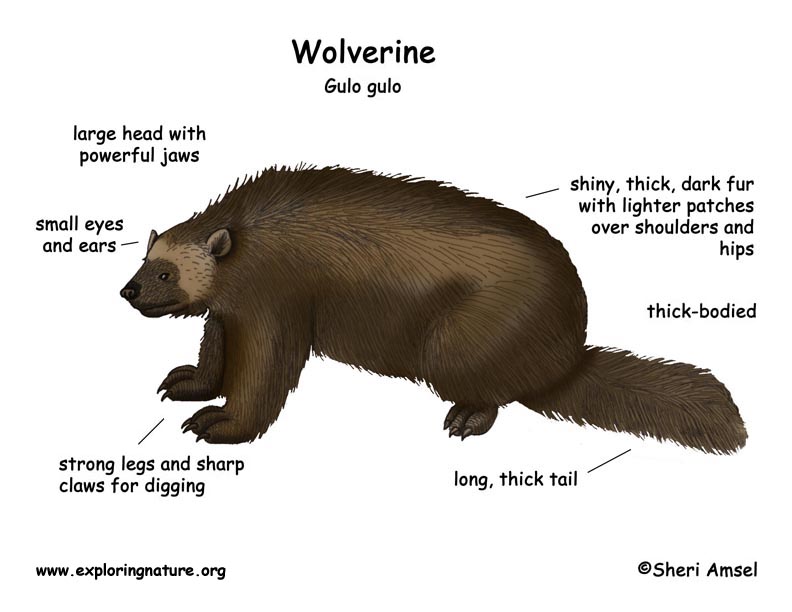
Classification
- Kingdom: Animalia
- Phylum: Chordata
- Subphylum: Vertebrata
- Class: Mammalia
- Order: Carnivora
- Suborder: Caniformia
- Family: Mustelidae
- Subfamily: Mustelinae
- Genus: Gulo
- Species: Gulo gulo